

The Science and Marketing Behind Professional Detailing Products
The Science and Marketing Behind Professional Detailing Products
Why Great Chemistry Will Always Outperform Great Marketing
Spend a few minutes shopping for automotive detailing products today and you’ll notice a familiar pattern. Nearly every bottle promises something extraordinary. One product delivers “extreme gloss.” Another advertises “professional-grade ceramic technology.” A third claims to use graphene, nanotechnology, or proprietary polymers that supposedly outperform everything else on the market.
Innovation has unquestionably made today’s detailing products better than ever before. Modern soaps clean more safely, ceramic coatings last longer, and protective technologies continue to evolve. Yet all of that innovation has also created something else—confusion. For many vehicle owners, it’s becoming increasingly difficult to separate genuine advancements in chemistry from creative marketing.
After spending decades in the automotive appearance industry, I’ve learned that the best products rarely become successful because they have the loudest advertising. They earn their reputation because the chemistry consistently delivers results. That’s exactly why we created the Lumin8 Science Library.
This series isn’t designed to convince you that one brand has all the answers. Instead, it’s meant to explain the science behind automotive detailing in plain English. Whether you’re maintaining your daily driver, restoring a classic car, or running a professional detailing business, understanding why products work will always help you make better decisions than simply believing the claims printed on the front of a bottle.
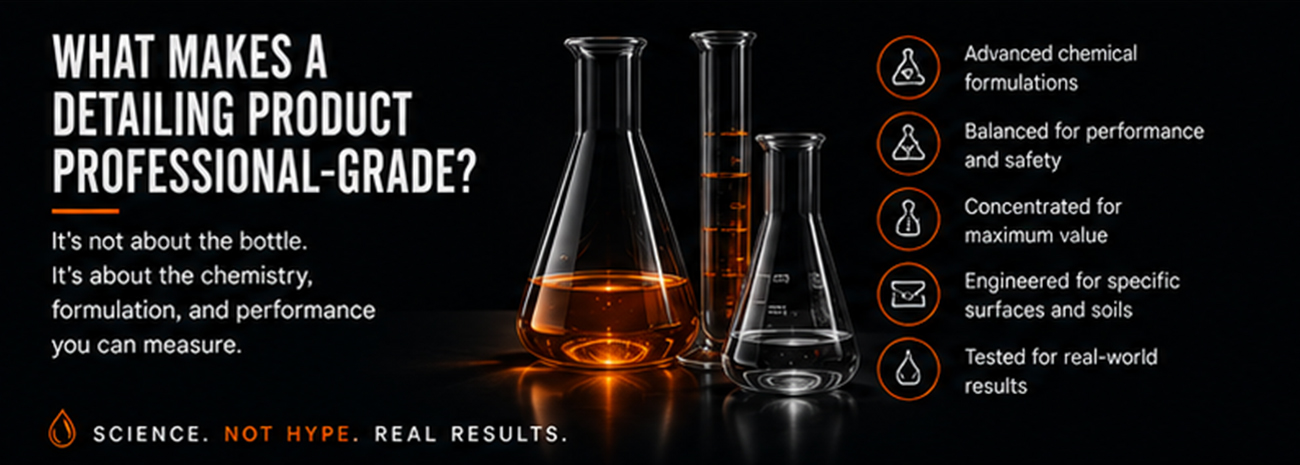
Every Great Product Begins with a Problem
One of the biggest misconceptions about detailing chemicals is that they’re created by combining a handful of ingredients and giving the mixture an attractive label. In reality, professional product development begins with a much simpler question:
What problem are we trying to solve?
Should the product safely remove road grime without stripping existing protection? Does it need to restore faded trim? Is its job to leave behind durable hydrophobic protection, or simply clean the surface without interfering with an existing ceramic coating? Every successful product starts by defining its purpose before a chemist ever begins selecting raw materials.
Once that objective is established, formulation becomes an exercise in balance. Every ingredient has a specific responsibility, and every decision affects the final performance of the product. Change one surfactant, solvent, polymer, or stabilizer, and you’ve changed the way that product behaves on the vehicle.
From the outside, two detailing sprays might look nearly identical. Inside the bottle, however, they can be completely different products engineered for completely different outcomes.
Why Chemistry Is Really About Balance
Consumers often assume that more ingredients automatically create a better product. It’s an understandable assumption because we naturally associate “more” with “better.” Chemistry rarely works that way.
Think about baking fresh bread. Adding extra flour doesn’t improve the recipe. Too much yeast can ruin the texture. Too much salt overwhelms every other ingredient. Great baking isn’t about using the most ingredients—it’s about getting the proportions exactly right.
Professional detailing products work much the same way. Some formulas contain sophisticated combinations of surfactants, lubricants, corrosion inhibitors, UV stabilizers, solvents, and polymers. Others achieve outstanding performance using surprisingly simple chemistry. Neither approach is inherently better. What matters is whether every ingredient contributes toward solving the original problem the product was designed to address.
That’s one of the reasons experienced professionals often evaluate products differently than casual consumers. They aren’t impressed by long ingredient lists or flashy marketing language. They’re looking for predictable performance, repeatability, and products that consistently deliver the same results day after day.
Marketing Opens the Door. Chemistry Decides Whether You Stay.
Marketing has an important job. It introduces new technology, tells the story behind a product, and encourages someone to give it a chance. There’s absolutely nothing wrong with that. Without marketing, many genuinely innovative products would never reach the people who could benefit from them.
The challenge arises when marketing becomes the entire conversation.
A well-designed label can encourage someone to purchase a product once. A compelling social media video might generate thousands of sales overnight. Neither one determines whether professionals continue buying that product six months later.
Real-world performance does.
Professional detailers quickly discover whether a wheel cleaner stains delicate finishes, whether a soap leaves unwanted residue, or whether a spray sealant performs consistently in direct sunlight. Their livelihood depends on producing reliable results, so chemistry becomes far more important than advertising.
That’s why you’ll often hear experienced installers say they trust products they’ve used for years rather than chasing every new trend. They’re not resisting innovation. They’re simply waiting for the chemistry to prove itself.
When Scientific Terms Become Marketing Buzzwords
The detailing industry has introduced some remarkable technologies over the last two decades. Ceramic coatings transformed long-term paint protection. Modern polymers dramatically improved durability. New surfactant technology made cleaning both safer and more effective.
Unfortunately, many scientific terms eventually become marketing buzzwords.
Words like ceramic, graphene, nano, and professional grade immediately capture attention because they sound technical and innovative. The problem isn’t that these terms are inaccurate. The problem is that they’re often presented without enough context to help consumers understand what they actually mean.
Take ceramic technology as an example. Saying a product is “ceramic infused” doesn’t automatically tell us how it performs. Does it provide months of protection? Is the ceramic component simply improving slickness? Is it designed as a maintenance product rather than a stand-alone coating? Those are very different products, even though they might all use the same marketing term.
This doesn’t make the marketing dishonest. It simply means the conversation is incomplete.
Throughout this series, we’ll dig deeper into those conversations so you understand not just what a product claims to contain, but why those ingredients matter in the first place.

What Professionals Notice That Consumers Often Miss
When most people evaluate a detailing product, they focus on the immediate result. Does the paint look glossy? Does water bead nicely? Does the vehicle feel slick?
Professional product developers think about an entirely different set of questions.
Will the formula remain stable after sitting in a warehouse for a year? Can it survive repeated freeze-and-thaw cycles during shipping? Will it perform the same in Arizona’s summer heat as it does during a Michigan winter? Is it compatible with modern clear coats, paint protection film, vinyl wraps, and existing ceramic coatings?
Those aren’t the kinds of questions that appear on product labels, but they’re often the difference between a product that performs well once and one that earns the confidence of professionals for years.
Great chemistry isn’t measured only by how impressive a vehicle looks immediately after application. It’s measured by how consistently that performance can be repeated over time.
Why Education Is Becoming the Industry’s Greatest Tool
The automotive detailing industry has never had more access to information. At the same time, it has never been easier for misinformation to spread. Short videos, catchy slogans, and dramatic demonstrations often oversimplify topics that deserve a more thoughtful explanation.
That’s why education matters.
Understanding concepts like pH, lubricity, surfactants, polymers, and protective chemistry doesn’t require a chemistry degree. It simply requires someone willing to explain them in a way that makes sense.
The goal of the Lumin8 Science Library isn’t to overwhelm readers with scientific terminology. Our goal is much simpler: to help you understand enough about the science that marketing becomes easier to evaluate on your own.
Once you understand how detailing products actually work, you stop asking, “Which bottle has the most impressive label?” and start asking much better questions.
Those questions almost always lead to better products—and better results.
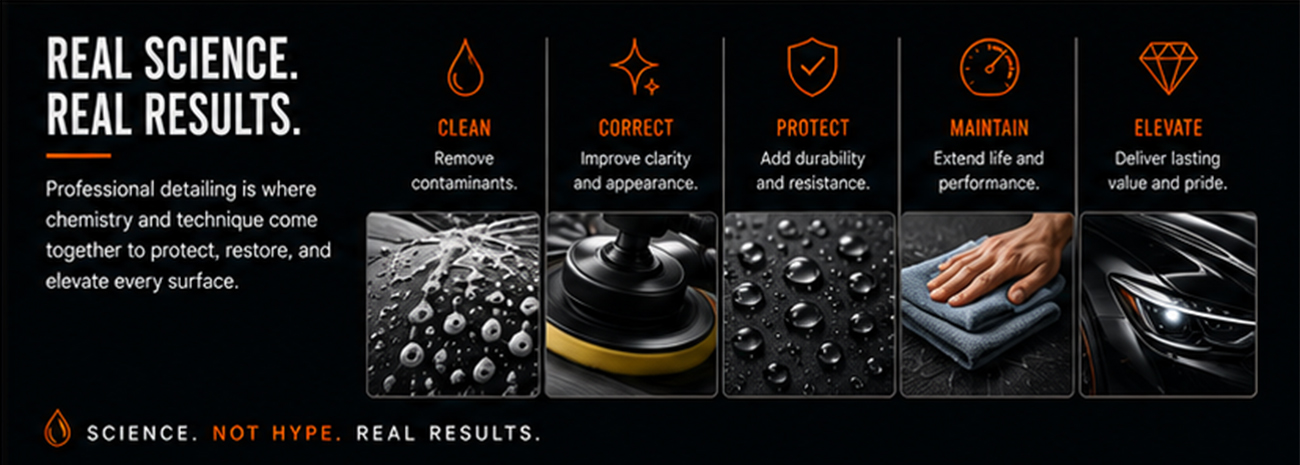
Looking Ahead
This article is only the beginning. In future editions of the Lumin8 Science Library, we’ll explore ceramic coatings, graphene technology, paint protection coatings, surfactants, pH chemistry, lubricity, hydrophobic behavior, paint decontamination, and many of the industry’s most common misconceptions.
Sometimes we’ll discover that the marketing is fully supported by the science. Other times, we’ll find that the chemistry tells a more interesting story than the advertising ever could.
Either way, we’ll let the science lead the conversation.
Because in the long run, the products that stand the test of time aren’t remembered for their slogans.
They’re remembered for their performance.